

DOWNLOAD PDF
June 19, 2026
By Yves Genest, Senior Advisor, Project Audits, Office of the Auditor General of Manitoba
|
Artificial intelligence is reshaping the audit apprenticeship model by automating many of the routine tasks that historically supported the development of junior auditors. As these foundational learning opportunities decline, audit organisations face a critical challenge: how to sustain the development of judgement, professional scepticism, and audit capability while preserving audit quality over the long term. Key strategies include:
Together, these approaches enable a human-centred audit model that balances efficiency gains with sustained professional expertise. 1. Introduction: The Disruption of the Audit ApprenticeshipFor decades, the audit profession has relied on an apprenticeship model in which junior auditors developed by performing repetitive, low-risk tasks such as vouching, reconciliations, and basic testing. Although routine, these activities served an important developmental purpose. They exposed junior staff to audit evidence, systems, and processes, allowing them to build professional judgement, scepticism, and intuition over time. This model has been central to sustaining audit quality. By repeatedly carrying out basic procedures under supervision, junior auditors learned how evidence is generated and assessed, how anomalies emerge, and how risk becomes visible in practice. Much of this learning occurred implicitly through experience rather than through formal instruction. The rapid advancement of artificial intelligence (AI) is now reshaping this model. AI tools can automate or accelerate many of the tasks that historically underpinned early-career development, including reconciliations, anomaly detection, and elements of testing (Fedyk et al., 2022; Financial Reporting Council [FRC], 2026). While these tools offer significant efficiency gains, they also compress or remove the training ground through which junior auditors traditionally acquired foundational capabilities. This creates a structural tension for audit organisations. In the short term, automation improves efficiency and reduces the need for manual work. In the longer term, however, it may weaken the pipeline of experienced auditors if alternative development pathways are not deliberately created. Evidence from other professions suggests that the erosion of entry-level work can undermine the development of future expertise when training models are not redesigned (Brynjolfsson et al., 2025; Edmondson & Chamorro-Premuzic, 2025). The implications for audit quality are significant. Auditing depends not only on technical procedures but also on professional scepticism and judgement. These capabilities must be cultivated deliberately in technologically mediated environments (International Auditing and Assurance Standards Board [IAASB], 2024a). Without sufficient exposure to foundational tasks, future auditors may lack the depth of understanding required to critically assess evidence. Accordingly, the impact of AI on junior auditors should be understood as a workforce redesign challenge. The central issue is how audit organisations can ensure that essential professional capabilities continue to develop when traditional learning pathways are no longer available. Addressing this challenge requires rethinking how capability is developed. Figure 1 synthesises the shift from a traditional apprenticeship model to a redesigned, human-centred approach. Figure 1 -Transformation of the Audit Apprenticeship Model in an AI Environment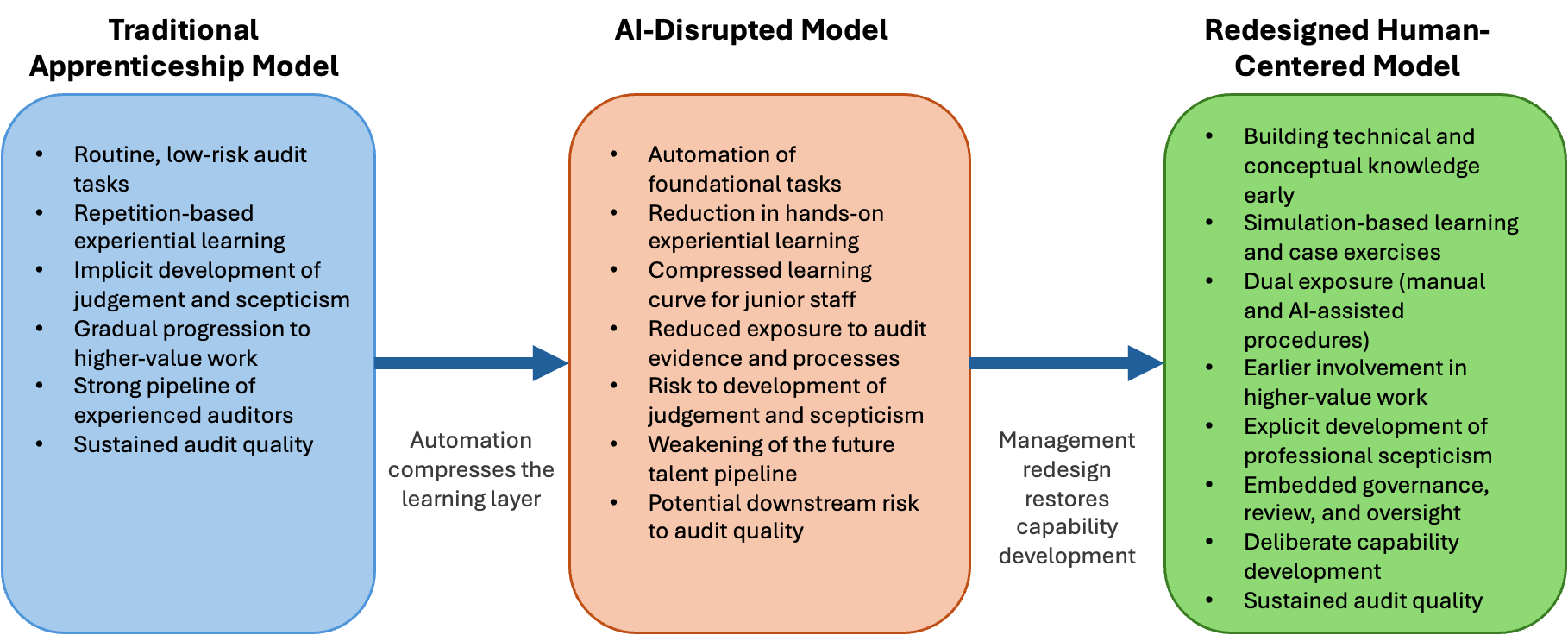 2. Reimagining Early-Career DevelopmentAddressing this challenge requires a fundamental rethinking of how early-career development is structured. As routine tasks are reduced or eliminated, audit organisations can no longer depend on passive, experience-based learning. Instead, they must shift from learning by doing to learning by design, creating explicit development pathways that replace what was once acquired informally through repetitive work. A central response is to provide foundational knowledge early in a career. Historically, junior auditors acquired technical understanding gradually through repeated exposure to basic procedures. In an AI-enabled environment, that approach is no longer sufficient. Audit firms are therefore intensifying early training in audit concepts, risk assessment, and professional scepticism (Institute of Chartered Accountants in England and Wales [ICAEW], 2026; PwC, 2025). This approach helps ensure that junior auditors understand the logic and limitations of AI-enabled procedures rather than relying on outputs uncritically. Simulation-based learning is increasingly important in this redesigned model. Mock audits, case-based exercises, and AI-assisted training environments allow junior auditors to practise both traditional and technology-enabled procedures in controlled settings. These methods preserve conceptual learning while reducing dependence on routine live-file work. They also create opportunities to test judgement, interpretation, and scepticism before these capabilities are applied in higher-risk audit contexts. The broader concern that professionals may struggle to develop new skills when foundational tasks are automated reinforces the importance of such deliberate design (Pitstick, 2026). Dual exposure models also play an important role. By performing selected tasks both with and without AI support, junior auditors can better understand underlying processes and the basis for professional conclusions. This reduces the risk of over-reliance on automation and strengthens evaluative capacity. Evidence from other professions indicates that individuals who actively engage with underlying reasoning are better positioned to detect error and exercise judgement than those who simply accept machine-generated outputs (Edmondson & Chamorro-Premuzic, 2025). At the same time, AI enables earlier exposure to higher-value work. Junior auditors can be involved sooner in analytical review, risk assessment, and stakeholder interaction. However, this acceleration must be carefully managed. Without adequate support, organisations risk assigning complex responsibilities before junior staff have developed the conceptual grounding required to carry them out effectively. Professional scepticism therefore needs to be taught more explicitly than in the past. In the traditional model, scepticism often developed through repeated exposure to evidence and supervisory review. In an AI-mediated environment, it must be embedded deliberately in training through exercises that require junior auditors to question outputs, investigate anomalies, and justify conclusions. This is consistent with the IAASB’s emphasis on scepticism as a core professional competency (IAASB, 2024a). Overall, effective early-career development now depends on deliberate design, combining structured training, simulation, and controlled exposure to higher-value work. However, redesigning how junior auditors learn is only one part of the solution. As their roles evolve, the systems that govern audit quality must also adapt. 3. Oversight, Accountability, and Quality Management in an AI EnvironmentThese changes place increased demands on oversight, accountability, and quality management in an AI-enabled audit environment. AI adoption does not reduce the need for governance; it increases it. As audit processes become more automated, risk shifts from manual execution errors toward issues such as data integrity, model reliability, and inappropriate reliance on generated outputs. Research showing that AI can significantly alter audit processes reinforces the importance of carefully governing how evidence is produced, interpreted, and documented (Fedyk et al., 2022). A central principle is that accountability does not change simply because AI is used. Audit teams remain responsible for audit quality regardless of the extent to which technology has informed or executed particular procedures (FRC, 2026). Similarly, the IAASB has emphasised that professional judgement and scepticism remain essential in technologically supported audits (IAASB, 2024b). Public sector commentary reflects similar concerns, with attention being drawn to how AI may alter junior roles and thus require revised approaches to oversight and supervision (Hayes, 2026). In practice, this means embedding AI use within existing quality management frameworks rather than treating it as a standalone capability. Organisations need policies that define permitted uses of AI, controls over data inputs, validation expectations, and documentation requirements. AI should be incorporated into the broader control environment and subject to the same discipline as other audit methodologies and tools. Risk-based human oversight is particularly important. Audit workflows should include mandatory review points where auditors validate, corroborate, and challenge AI-generated outputs, especially when those outputs are material to audit conclusions. Such review points help ensure that conclusions are not based solely on automation and that junior auditors remain engaged in evaluating evidence rather than merely processing results. Clear accountability structures are equally necessary. Organisations must define who is responsible for configuring tools, reviewing outputs, approving their use, and documenting conclusions. Without such clarity, there is a risk that responsibility becomes diffuse, weakening both oversight and training. Documentation standards must also evolve. In AI-assisted audits, it is not enough to record only the result of a procedure. Audit files should also show how AI was used, what inputs were relied upon, and how outputs were validated. Finally, governance depends not only on formal controls but also on culture. A major risk in AI-enabled settings is that junior staff may treat generated outputs as inherently authoritative. Evidence suggests that uncritical reliance on AI can weaken analytical engagement and performance (Edmondson & Chamorro-Premuzic, 2025). Organisations must therefore reinforce norms that privilege scepticism, challenge, and judgement over speed alone. In summary, the use of AI in auditing requires stronger oversight, not less. Yet governance alone is insufficient. As AI reshapes how work is performed, it also changes what it means to be an auditor and how careers must develop over time. 4. Redefining Roles and Career PathwaysThis shift necessitates a redefinition of roles and career pathways within the audit profession. The traditional linear progression from routine execution to complex judgement is increasingly difficult to sustain when foundational tasks are automated. In its place, more hybrid career models are emerging, requiring junior auditors to combine traditional audit competencies with data and AI literacy. Future auditors are expected not only to understand audit methodology but also to interpret AI outputs, assess their reliability, and recognise their limitations. This hybrid skill profile is becoming increasingly central to modern audit work (Kenney, 2026; MacTavish et al., 2026). Evidence also suggests that AI is already altering entry-level accountancy roles in practice, underscoring the urgency of redesign rather than gradual adaptation (PQ Magazine, 2026). As these changes unfold, new roles are beginning to appear within audit teams, including AI-enabled auditors, data-informed auditors, and staff with responsibilities for overseeing or validating AI-supported processes. Although these roles are still evolving, they share an emphasis on interpretation, review, and control rather than basic execution. As summarized in Table 1, organizations must take a proactive and diversified approach to these challenges.
To preserve learning opportunities, organisations must be more deliberate in how they allocate work. Some tasks may need to be retained, adapted, or re-performed manually for developmental purposes. The objective is not to resist automation, but to ensure that junior auditors still encounter the kinds of evidence, ambiguity, and analytical challenge that build professional judgement. Observations from other professions suggest a similar trend: organisations are redesigning junior roles rather than eliminating them, often by shifting emphasis from routine production to validation, interpretation, and higher-order analysis (Deloitte, 2026; Martin, 2026). This point is critical because short-term efficiency gains can obscure long-term capability risks. If organisations reduce entry-level roles without redesigning them, they may weaken the future supply of experienced professionals. That concern has already been raised in cross-professional commentary warning that the removal of formative early-career work may undermine the development of future leaders and specialists (Edmondson & Chamorro-Premuzic, 2025). Career pathways must therefore remain both credible and attractive. Junior auditors need visible progression routes that reflect evolving role requirements while still preserving a strong professional foundation. In summary, redefining roles and career pathways requires a balance between innovation and continuity. To determine whether these redesigned pathways are working, however, organisations must also monitor how the talent pipeline is evolving over time. 5. Monitoring and Managing the Talent PipelineThis makes the active monitoring and management of the talent pipeline a critical component of AI adoption in auditing. Traditional performance metrics, such as task volume or utilisation, are no longer sufficient when foundational work is increasingly automated. Organisations need a broader set of indicators that show whether junior auditors are developing the competencies required for long-term audit quality.(Deloitte, 2026; Pitstick, 2026). A useful approach is to distinguish between leading and lagging indicators. Leading indicators include completion of structured training, participation in simulation-based learning, and demonstrated competence in areas such as risk assessment and evidence evaluation. Lagging indicators include audit quality outcomes, review findings, and error rates. Together, these measures provide a more complete picture of whether redesigned development models are producing the intended results (Deloitte, 2026).. Audit outcomes can also serve as indirect measures of training effectiveness. Patterns in internal quality reviews or external inspections may reveal whether junior auditors are developing sufficient judgement, scepticism, and documentation discipline. Increases in deficiencies related to evidence evaluation or weak support for conclusions may indicate gaps in training or role design, whereas stable or improved quality results may suggest that mitigation strategies are working (Financial Reporting Council [FRC], 2026; International Auditing and Assurance Standards Board [IAASB], 2024b). Regular feedback loops are equally important. Input from supervisors, engagement leaders, and junior staff can help identify where training, work allocation, or support mechanisms need adjustment. This is particularly important in an AI-enabled environment, where rapid technological change may quickly make existing development models obsolete. Continuous improvement therefore becomes an essential management discipline rather than an occasional exercise (Deloitte, 2026). Governance over the talent pipeline must also be strengthened. Senior leadership should treat workforce development as a strategic issue, not simply an operational matter. Without clear governance, short-term productivity incentives may overshadow longer-term capability development. Data-driven monitoring can support more targeted and adaptive responses by helping organisations refine training investments, work design, and career pathways over time (Brynjolfsson et al., 2025). In summary, managing the talent pipeline requires a shift from static performance metrics to dynamic, multi-dimensional monitoring. These insights support not only operational adjustment but also the broader strategic response to AI in the audit profession. 6. Conclusion: Building a Human-Centred AI Audit ModelTogether, these considerations point to a broader conclusion: the successful integration of AI in auditing depends on how effectively organisations align technology, people, and governance. AI is transforming how audits are performed, but it does not eliminate the need for human expertise. Rather, it changes where and how that expertise must be developed (IAASB, 2024b; Kenney, 2026). This article has argued that sustaining audit quality in an AI-enabled environment requires a dual response. First, audit organisations must redesign early-career development so that junior auditors continue to acquire professional scepticism, judgement, and a sound understanding of evidence. Second, they must strengthen oversight, accountability, and quality management arrangements so that technological efficiency does not come at the expense of defensibility, rigour, or professional responsibility (FRC, 2026; IAASB, 2024a). The risks of failing to adapt are substantial. If automation is introduced without corresponding changes to training and role design, the profession may experience a gradual erosion of capability as fewer auditors gain the depth of experience required for senior roles. Over time, this may affect audit quality, diminish the challenge applied to audit evidence, and weaken confidence in the profession. Evidence across professions suggests that reducing entry-level roles without redesigning them can undermine long-term capability development (Edmondson & Chamorro-Premuzic, 2025). Conversely, organisations that respond proactively have the opportunity to improve both efficiency and capability. AI can accelerate development pathways if combined with structured learning, earlier exposure to higher-value work, and stronger oversight (PwC, 2025; Deloitte, 2026). Several strategic priorities follow. Audit leaders should treat talent development as a core component of AI strategy, invest in structured and adaptable training models, and establish governance mechanisms that evolve alongside technological change. They must also ensure that the profession remains attractive to new entrants by offering credible and meaningful career pathways (Deloitte, 2026). Ultimately, AI should be treated not as a substitute for auditors, but as a catalyst for rethinking how expertise is cultivated and applied. A human-centred approach, combining technological innovation with deliberate investment in people, offers the most sustainable path forward. In that model, audit organisations can preserve both the efficiency gains available today and the professional capability required for tomorrow (Kenney, 2026). |
References
Brynjolfsson, E., Chandar, B., & Chen, R. (2025). Canaries in the coal mine? Six facts about the recent employment effects of artificial intelligence (Stanford Digital Economy Lab Working Paper). Stanford University. https://digitaleconomy.stanford.edu/app/uploads/2025/11/CanariesintheCoalMine_Nov25.pdf
Deloitte. (2026). The finance workforce of 2026: AI, skills gaps, and supply challenges. Deloitte Insights. https://www.deloitte.com/us/en/what-we-do/capabilities/finance-transformation/articles/finance-workforce-strategy-ai-era.html
Edmondson, A. C., & Chamorro-Premuzic, T. (2025, December 11). The perils of using AI to replace entry-level jobs. Harvard Business Impact Education. https://hbsp.harvard.edu/inspiring-minds/ai-impact-entry-level-jobs
Fedyk, A., Hodson, J., Khimich, N. V., & Fedyk, T. (2022). Is artificial intelligence improving the audit process? Review of Accounting Studies, 27(4), 938–985. https://doi.org/10.1007/s11142-022-09697-x
Financial Reporting Council. (2026). Guidance on the use of generative and agentic AI in audit. FRC. https://www.frc.org.uk/library/standards-codes-policy/audit-assurance-and-ethics/guidance/ai-in-audit/
Hayes, A. (2026, February 13). AI expected to transform junior audit roles, National Audit Office warns. Davenports Accountancy. https://www.davenportsaccountancy.co.uk/2026/02/13/ai-expected-to-transform-junior-audit-roles-national-audit-office-warns/
Institute of Chartered Accountants in England and Wales. (2025, July 17). AI: Should it replace junior roles? ICAEW Insights. https://www.icaew.com/insights/viewpoints-on-the-news/2025/jul-2025/ai-should-it-replace-junior-roles
Institute of Chartered Accountants in England and Wales. (2026, April 1). How Deloitte is reshaping its audit training for the AI age. ICAEW Insights. https://www.icaew.com/insights/viewpoints-on-the-news/2026/mar-2026/how-deloitte-is-reshaping-its-audit-training-for-the-ai-age
International Auditing and Assurance Standards Board. (2024a). Embedding professional scepticism. IFAC. https://www.iaasb.org/focus-areas/embedding-professional-scepticism
International Auditing and Assurance Standards Board. (2024b). The IAASB’s technology position statement. IFAC. https://ifacweb.blob.core.windows.net/publicfiles/2024-10/IAASB-Technology-Position-Statement.pdf
Kenney, A. (2026, February 1). How AI is transforming the audit and what it means for CPAs. Journal of Accountancy. https://www.journalofaccountancy.com/issues/2026/feb/how-ai-is-transforming-the-audit-and-what-it-means-for-cpas/
MacTavish, C., Fiolleau, K., Osecki, E., & Thorne, L. (2026). Technology and its implications for staff auditors. Accounting Horizons, 40(1), 103–115. https://doi.org/10.2308/HORIZONS-2023-057
Martin, T. (2026, February 2). The AI law professor: When AI forces us to rethink how we train junior lawyers. Thomson Reuters Institute. https://www.thomsonreuters.com/en-us/posts/legal/ai-law-professor-train-junior-lawyers/
Nelson, I., & Wedgeworth, C. (2025, April 2). Reinventing associate training for the age of AI. Artificial Lawyer. https://www.artificiallawyer.com/2025/04/02/reinventing-associate-training-for-the-age-of-ai/
Pitstick, H. (2026, March 1). How will accountants learn new skills when AI does the work? Journal of Accountancy. https://www.journalofaccountancy.com/issues/2026/mar/how-will-accountants-learn-new-skills-when-ai-does-the-work/
PQ Magazine. (2026, February 16). AI is already replacing junior accountancy roles. https://www.pqmagazine.com/ai-is-already-replacing-junior-accountancy-roles/
PwC. (2025, August 11). PwC to give junior accountants manager-level roles as AI handles routine work (reported by Moneycontrol). https://www.moneycontrol.com/technology/pwc-to-give-junior-accountants-manager-level-roles-as-ai-handles-routine-work-article-13437045.html
See more Research Highlights

 LinkedIn
 Twitter